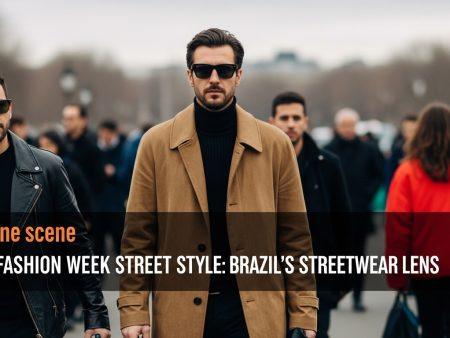
free Street Style Brazil: An in-depth look at how Brazil’s street style operates as public infrastructure, balancing accessibility, local craft, and urban.
Brazil’s street style has long been the mirror and the engine of urban life, but in recent years a phrase has emerged to describe a new dynamic: free Street Style Brazil. The idea frames fashion as a public language, not a boutique proposition, accessible in parks, bus stops, and improvised markets across cities—from São Paulo to Salvador. This analysis explores how that openness reframes style as social infrastructure, rather than mere taste.
Rethinking Street Style as Public Infrastructure
Street fashion is typically treated as personal expression, but in many Brazilian neighborhoods it functions like a shared resource. Sidewalks become racks, murals become backdrops for outfits, and transit hubs act as informal runways. The more accessible the space, the more diverse the participants: students, street vendors, taxi drivers, and artists all contribute to a temporary, evolving archive of what people wear and why. When public spaces are welcoming—adequate shade, lighting, safe routes, and low-cost access to fabrics or repurposed garments—the result is a distributed wardrobe that funds itself through exchange rather than sponsorship. This is the logic behind free Street Style Brazil: clothing and presentation become a commons, not a commodity controlled by a few labels.
Urban planners and designers increasingly recognize this dynamic. A productive street style scene can steer conversations about sidewalk width, shelter from rain at bus stops, and even air quality in crowded markets. Yet this same system also tests policy: who gets to display, who gets to participate, and who bears the risk when crowded spaces become stages for spontaneous performances? The answer, for now, lies in a continuum between informal networks and formal channels for support—where fashion acts as a minor public good rather than a private vanity project.
Economies of Label-Free Expression: Free Street Style Brazil Signals
The phrase signals more than a lack of brand logos. It signals a marketplace of ideas where upcycling, thrift shopping, and DIY tailoring drive both identity and economy. In many Brazilian cities, a look is quantified not by the price tag but by the story: a jacket patched with found fabric, sneakers repurposed from old soles, or a hat sewn together from leftover materials. This label-free economy competes with fast fashion by offering immediacy, locality, and resilience against supply chain shocks. The digital layer accelerates diffusion: street corners become pop-up studios, and social media acts as a regional fashion week that never closes.
Critically, free Street Style Brazil does not erase brands; rather, it democratizes access and questions who creates trends. Local artisans may anchor neighborhoods, while students critique fashion systems through remix culture. The result is a diffusion of style that transcends malls and media cycles, producing a national vocabulary of color, texture, and silhouette that is uniquely Brazilian and widely legible across regions.
Urban Spaces, Visibility, and Local Brands
Visibility in street style becomes a form of social capital. In dense urban cores, a distinctive silhouette can translate into opportunities—collaboration with local studios, mentorship in sewing circles, or even small gigs in visual storytelling for businesses. Yet visibility also creates tension: the risk of misappropriation, enforcement crackdowns on creative gatherings, or uneven access to hardware like sewing machines or repair services. The dynamic is most acute in cities with stark income disparities, where a good outfit for some is a survival resource for others. Local brands, from micro-enterprises to cooperatives, anchor neighborhoods by translating collective tastes into tangible goods. They partner with photographers, community centers, and street markets to maintain a steady stream of new, affordable attire that keeps the conversation alive without requiring expensive fashion week endorsements.
Regional variation matters: what São Paulo validates as cosmopolitan, Rio de Janeiro might reinterpret through beach-ready fabrics and lighter palettes, while Recife and Salvador bring Afro-Brazilian influences into a tropically infused palette. The shared thread is a mutual understanding that style travels fastest when it is grounded in daily life—on commutes, at block parties, and in improvised photo shoots along the avenues where the city breathes.
Actionable Takeaways
- Invest in safe, shaded, and accessible public spaces that support impromptu fashion showcases, from markets to transit hubs.
- Support local upcycling programs and sewing cooperatives that turn found materials into durable garments, expanding the free Street Style Brazil ecosystem.
- Encourage partnerships between community organizations and small studios to document and retail street style pieces ethically and transparently.
- Provide affordable access to basic sewing equipment and repair services to extend garment lifetimes and reduce waste.
- Develop city-level policy that protects spontaneous gatherings for creative expression while addressing public safety concerns.